Tuesday, 23 December 2008

Thursday, 18 December 2008
Congo Justice Report Launch
 Women in the Democratic Republic of Congo who have been raped during war are being imprisoned for aborting their resulting pregnancies, and then being left to starve in overcrowded cells. This is just one of the findings of a recent report, ‘Justice, Impunity, and Sexual Violence in Eastern DRC’, which was put together by a group from the UK parliament called the APPG Great Lakes of Africa. At the launch of the report, Jonathan Mance, the British Law Lord who headed the team, said that the time he had spent in the Congo was a “quite shocking experience”. Having recently returned from the DRC myself, I can safely say that Mance’s assertion that “government is little more than a phantom” in the east of the country is mirrored in the west.
By taking a close look at the DRC’s budget, however, Mance has put into concrete terms exactly how neglected the justice system is. The country budgets just $6 per prisoner per year, so starving behind bars is common, unless the prisoners can find a way to either bribe a guard, or break out. A lack of funds for new prisons means that overcrowding is endemic, and Mance highlighted one prison in Goma where 600 people were crammed into a facility built for 220. Many of those locked up are imprisoned without trial, due to the lack of effective legal proceedings, and while damage awards for military crimes totaling $1.5 million have been awarded, not a single penny has ever been paid. The entire budget for damage awards is just $5,000. Mance urged that the most important step was to “support, or rather, introduce the rule of law” as “justice is one of the pillars of a democratic state” and essential to “rid the DRC of the threat of random or targeted sexual violence.”
Also at the launch, Marie-Claire Faray, from Common Cause UK, a group which gives a platform to Congolese women, spoke passionately about the way that “war has shattered the lives of women”. She said that women in the Congo who have been the victims of sexual violence “live a non-existence, they are wreckages. Like vegetables, in so much sadness.” She highlighted the link between poor governance and the continuing violent attacks on women when she described them as “a consequence of a state which is not working” and asked “how can we implement protection for women when we are living in a state of anarchy?” “We have a human catastrophe happening before our eyes”, she said, and the only solution is that “power needs to go back to the people”.
Later, at an event to mark ten years of the APPG, former MP Oona King, who established the group, added her voice to those expressing their concern for the region, remarking wryly that while people in the UK might complain about public services, in the Congo there are “18 million people with no access to any services”. Both events demonstrated that while intervening in the internal politics of foreign countries is a difficult and controversial area, sometimes a different perspective can be essential in identifying problems and suggesting solutions.
This article was originally published by Ctrl.Alt.Shift
Wednesday, 26 November 2008
Meet Nadine
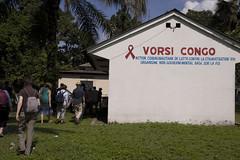
They travel across the whole country, training religious leaders, who in turn get their religious communities talking about the issues, often for the first time. Rodger, the technical director, estimated that across the 11 provinces of the DRC, their message has reached about 8million people. They try to break down the stigma surrounding HIV using mediums such as song & drama.
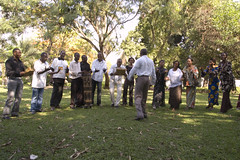
“Before, if you were HIV positive, no-one wanted to sit in the same pew as you at church. Now people are more happy to sit with them & even take communion with them.”
[Rodger]
I meet Nadine when we visited Vorsi Congo. She is the pastor of a church, and also is a woman living with HIV.
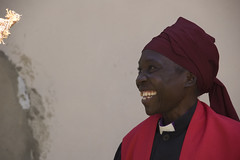
At one point as she shared her story with us, she said, “If I hadn’t have worked with Vorsi Congo, I’d be buried.” It really is a matter of life and death for people. The level of stigma surrounding HIV is still massive, and though Nadine is doing well, there are many people who have been shunned by their families and their churches when they find out they are HIV+.
We use this phrase a lot at Christian Aid, about ‘living positively with HIV’, and it’s only after meeting Nadine that I’m starting to understand what that really means. Nadine doesn’t sit around feeling sorry for herself, but instead she’s throwing herself into being a part of the solution. She’s using her story and her position in the church to help educate people.
To find out more about the issues surrounding HIV/AIDS, visit our website here.
To support our DR Congo crisis appeal , click here.
Wednesday, 19 November 2008
A personal privilege...
"Lord, I thank you that we can pray not only for the Congo as a whole, but also for these individual people: their lives, their hopes and fears."
This just made me realise that, although it is a privilege to have even been to the Congo and seen a glimpse of the country and its culture, the real privilege is that we got to meet such amazing people and talk to them about things that mattered to them. These people aren't just "people from the Congo" or even "people from 'Partner X' in Kinshasa". They are Nana from Project Photo, who told us about the stigma surrounding HIV in her family; Santa from the university in Kinshasa who confided in us that she can't trust her male lecturers; Neil who is part of the VORSI Congo choir and spoke to us about their work. They are real people. And I think its important for us to remember this as well, as we go out and tell their stories - to remember that they aren't just a name in our notebook or a face in a photograph.
How privileged we are to have met them! Though we can speak of the Congo as one whole, massive country, its these individual lives that make it, and that made our trip. I hope I never forget them.
Sunday, 16 November 2008
West vs East
I have been back in the UK for a week now and I still don't feel that I have quite accepted the culture we live in. But I don't think that is a bad thing. I don't want to find myself becoming so comfortable in it that I forget about the people we met in the DRC. But I reassure myself that these people have had such a deep impact on me, that this won't be possible. Flicking on my TV to see the DRC as a main headline just fuelled my passion even further to get out and start yelling the message of desperation but yet hope of the DRC to the UK.
I keep coming back to the phrase one of the students said to us when we were out there 'we are living for a better tomorrow', and I want to have my role in making it a better tommorrow for them.


