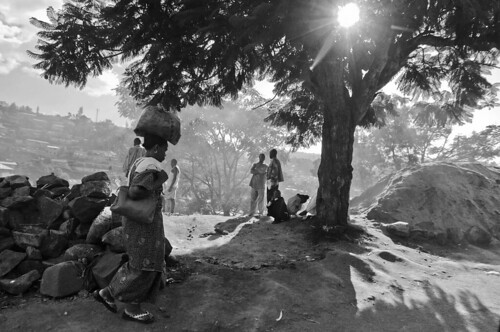
 Tim Butcher’s book, ‘Blood River: A Journey to Africa’s Broken Heart’, part-travelogue, part-history of the Congo, topped bestseller lists early this year. The premise of the book was that Butcher would follow in the footsteps of Stanley, the first man to map the length of the Congo River, and in doing so tell the story of the country. We had the chance to speak to Butcher recently about his experiences.
You seem to spend every moment of the book in fear for your life, did you actually enjoy the experience?
“I think enjoy would be the wrong word. It was an ordeal, and it was challenging and rewarding, but I wouldn’t say I enjoyed it. I’ve been told that there aren’t many laughs in the book, and I’m afraid that that’s because you can’t really make light of the situation. Of course I enjoyed meeting the fantastic people who helped me, but that enjoyment was tempered by the fact that I had to leave them there. I’m still in contact with Benoit, who was one of the motorbike drivers who took me on a large part of the journey, and since the book he has lost his job with Care International simply because they were downsizing their operation. He is now forced to eke out a shitty, miserable living, while in a stable country he’d have a great job, maybe the head teacher of a school. Benoit is one of the most incredible men I’ve ever met, and I would trust him with my life – well, I did trust him with my life. Some people accused me of being too negative in the book, but I reject that claim. I think I wrote about the way that the human spirit had survived, but it’s not a situation to be made light of. I think I was realistic in the book.”Why were the local Congolese people happy to go so far out of their way to help you on your journey?
“The milk of human kindness runs very deep there. People like Benoit and Georges Mbuyu, the pygmy leader, didn’t even ask for money. They really wanted to help me. The people of the Congo are incredibly generous. It’s one of those classic cases of a tiny fringe of radicals colouring the perception of an entire group of people.”Your journey wasn’t just unusual in that it was done by a non-Congolese person, even the locals rarely travel through the dangerous eastern provinces. How unified can the country be if communities are so isolated?
“That’s a very good question, because why would the country be unified along such arbitrary geographic lines? – lines drawn up by the very worst kind of colonialism. Amazingly there is a national identity, though, because the country passes the football test. Everybody cheers for the Simba. It’s astonishing, but even in areas of the country where it’s impossible to get television coverage of the games, everybody knows that there’s a game on and are behind the team. Since the 60s with Katanga, none of the regions have really talked of secession. I mean, some rebels have talked about making various provinces independent, but it’s just pie in the sky. Considering that it’s basically a failed state there is a remarkable amount of national unity.”
 ‘Blood River’ mentions the lack of institutional memory, the fact that the reasons for fighting wars can quickly be forgotten. Is Patrice Lumumba remembered as a hero of independence?
"It’s difficult to have that memory because it’s a country of young people. Lumumba doesn’t really have a Mandela-like following. He was a man of his time, and his murder was shrouded in so much mystery. It's only relatively recently that the truth has come out. The violence is so complicated and multi-layered that it is difficult for anyone to keep track of it and remember it.”The book is full of examples of decaying infrastructure, as the jungle reclaims roads and train-tracks. Is there a part of you that enjoys the unspoilt nature of the rainforest?
"If I could guarantee that my children would be safe and that my wife wouldn’t be raped, then the Congo would be a beautiful place to visit. It’s an incredible environmental paradise.”What does the Congo need, above all else?
“There are strange benefits. It is an African irony that HIV started in the Congo, the first samples are from Leopoldville, and there’s evidence from the 30s, 40s and 50s. But the country hasn’t been that badly affected by HIV. There is HIV there, certainly, but it hasn’t spread as rapidly as it could have done, simply because the transport infrastructure isn’t there. HIV needs two things to spread quickly: poverty and good transport, and that’s why countries like Botswana and South Africa have been so badly affected.”
“So there is a positive side to the unspoilt nature. The oxygen we breath comes from the Congo rainforest, it’s one of the lungs of the world. And the unfortunate fact is that I can guarantee that the first roads that go into those areas will be logging roads.”
“Some of the remoter regions support fantastic ecosystems. An expedition recently found something like nine new species of mammal. So there is a pure, exciting, Garden of Eden, element to the country, but at the moment it’s not safe for the people.”
“The rule of law, and transparency. People have to know that if someone takes something that belongs to them, they can do something other than take a gun and shoot them. There is money in the country. The cobalt mines are generating fantastic amounts of money, but where is it going? Into Swiss bank accounts. Of course it’s easy for me to say what the Congo needs. The million dollar question, the million dollar developmental question, is how you implement the rule of law and transparency.”